How to Clean Solar Panels? A Step-by-Step Guide
A photovoltaic installation makes it possible to generate green electricity directly from solar radiation. In this way, both consumers and businesses can achieve energy independence and significantly reduce their electricity bills. Is regular cleaning of solar panels necessary to maintain their full efficiency? We answer!
Do Solar Panels Need Cleaning? Facts and Myths
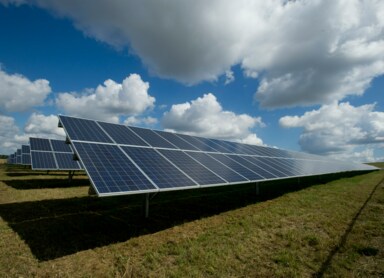
You can read a lot online about photovoltaic installations being maintenance-free. Once installed, they can operate for several decades, generating electricity. In simplified terms, the operation of silicon panels is indeed very straightforward, but it is important to remember that regular cleaning of the front protective layer is necessary to maintain the system’s full efficiency. Why is that? First, it is worth taking a look at how solar panels are built.
At the top, there is a thin semiconductor layer and a positive electrode with an anti-reflective coating. At the bottom, there is a negative electrode with a thicker semiconductor layer. At the back of the panel, there is an electrically insulating film or tempered glass (in glass-glass models). The front part of the cell is also covered with tempered glass, which protects the delicate structural components from mechanical damage and moisture while ensuring good transmission of sunlight.
When the glass protecting the photovoltaic panels becomes dirty, the silicon cannot absorb photons optimally, so electricity production is lower than it could be considering the system’s power output measured in kilowatt-peak (kWp). In particular, the following should be removed from the surface of solar panels:
- soot,
- smog,
- bird droppings,
- decayed plant residue,
- insect remains.
It is true that solar panels need cleaning. However, it does not necessarily have to be done very often unless the glass covers become heavily soiled, for example during facade or roof renovation work. Large stains on panels can reduce the system’s efficiency by as much as 10–15%. Over the course of a year, these losses can become significant.
Another issue related to dirty panels is the so-called “hotspots.” These are areas where a panel heats up much more intensely than in other places, which may lead to failure of the entire installation. The most common causes of hotspots are permanent shading of part of the system, leading to uneven heating, as well as infrequent cleaning and the accumulation of stubborn dirt. The effects of hotspots may include accelerated system wear, cracks in the protective glass, and in extreme cases, even fire. A solution to the problem of uneven heating in PV systems is the use of bypass diodes, which disconnect excessively overheated cells.
What Should You Use to Clean Solar Panels Without Damaging Them?
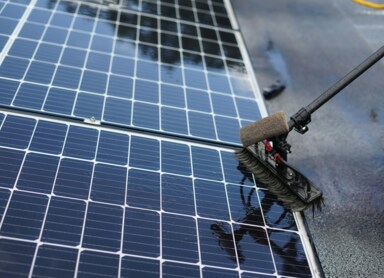
Professionals recommend cleaning panels with demineralized water, which does not leave streaks or particles that could scratch the glass surface. Soft sponges and extension brushes are typically used for this purpose. They should not be pressed too hard against the cleaned surface. The use of metallic sponges or brushes with hard edges is strongly discouraged.
Strong corrosive cleaning agents, such as those based on sodium hypochlorite, should not be used on photovoltaic panels. It is worth investing in a specialized, gentle detergent. It should not contain alcohol and should be environmentally neutral. Good cleaning products are often based on alkaline water and potassium hydroxide. As a last resort, you can also use regular glass cleaner or a natural vinegar-based solution.
How to Clean Solar Panels Yourself: Step-by-Step Guide
The cost of cleaning photovoltaic panels mainly depends on the area to be cleaned, the need for specialist equipment for working at heights, and local service prices. Average costs range from approximately PLN 15–20 per square meter of panels or around PLN 25–30 per panel. If you do not want to hire professionals, you can clean the panels yourself. However, it is important to prepare properly.
First of all, never work on overheated solar panels. You can easily burn yourself or damage the installation components. The best time for cleaning is early morning or late afternoon. Cold water coming into contact with a panel heated to 70–80°C may cause the glass to crack.
Try to avoid using pressure washers. A typical pressure lance produces water pressure exceeding 100 bars, which can easily lead to leaks in the installation. A much better solution is to use a brush with an extension pole. Ground-mounted systems are much easier to maintain than rooftop systems. If you are cleaning panels at height, ensure proper safety measures. A protective helmet and a sturdy ladder are the absolute minimum.
Use demineralized or rainwater for cleaning. It helps remove even stubborn dirt without damaging the delicate cell components. Also, avoid walking on the panels. Although they are designed to withstand the static load of snow, concentrated pressure from stepping on them may damage the installation.
Remember to switch off the photovoltaic system before cleaning. This eliminates the risk of a short circuit within the electrical circuits. First use the DC switch, then the AC switch. Disconnecting the power supply ensures that cleaning is completely safe for the user.
What Determines the Cost of Solar Panel Cleaning?
Several factors influence the price of panel cleaning services, including:
- the surface area of the photovoltaic system to be cleaned,
- the need for specialist equipment such as boom lifts, cleaning robots, or foam sprayers,
- panel accessibility, since ground-mounted systems are easier to clean than rooftop installations.
Cleaning Solar Panels – When and How Often Should It Be Done?
There is no single rule regarding how often solar panels should be cleaned. Generally, it is recommended to do so twice a year — in early spring and late autumn. For users operating installations in dusty environments, more frequent cleaning may be necessary. This applies, for example, to farms or companies located near busy roads.
It is certainly not worth postponing cleaning for too long. Dried-on dirt becomes more difficult to remove, which may increase service costs. In businesses, such work should be scheduled just like green space maintenance, cleaning, or technical inspections.
Similarly, in the case of solar farms operating under Power Purchase Agreements (PPAs), maintaining production at a specified level may require more frequent panel cleaning. This helps maintain high productivity.
Cleaning photovoltaic panels yourself is inexpensive, but it is also time-consuming and sometimes dangerous. Additionally, lack of experience or improper equipment may lead to damage to the entire structure. If you want to ensure that the work is carried out professionally and efficiently, we strongly recommend entrusting it to specialists.
At REO.pl, we promote sustainable business development. If you would like to learn how your organization can care for the environment while increasing its potential, we would be happy to help. Discover how solar energy can be a cheap and reliable source of electricity that also provides energy security.